
Model Context Protocol (MCP): Revolutionizing AI Agent Architecture


🧠 Introduction: The Orchestra Without a Conductor
Imagine an orchestra where each musician plays beautifully, but there's no conductor to coordinate the performance. That's the current state of many AI systems—powerful individual components without a unified way to communicate and collaborate. Enter the Model Context Protocol (MCP), a revolutionary approach that's changing how AI agents interact with their environment and each other.
In this technical deep dive, we'll explore MCP through the lens of a story—the evolution from disconnected API calls to a harmonious ecosystem of AI agents working in concert. We'll see how MCP differs from traditional APIs, examine its architecture, and implement a real-world agentic application that showcases MCP's capabilities
Refer: https://github.com/appcypher/awesome-mcp-servers
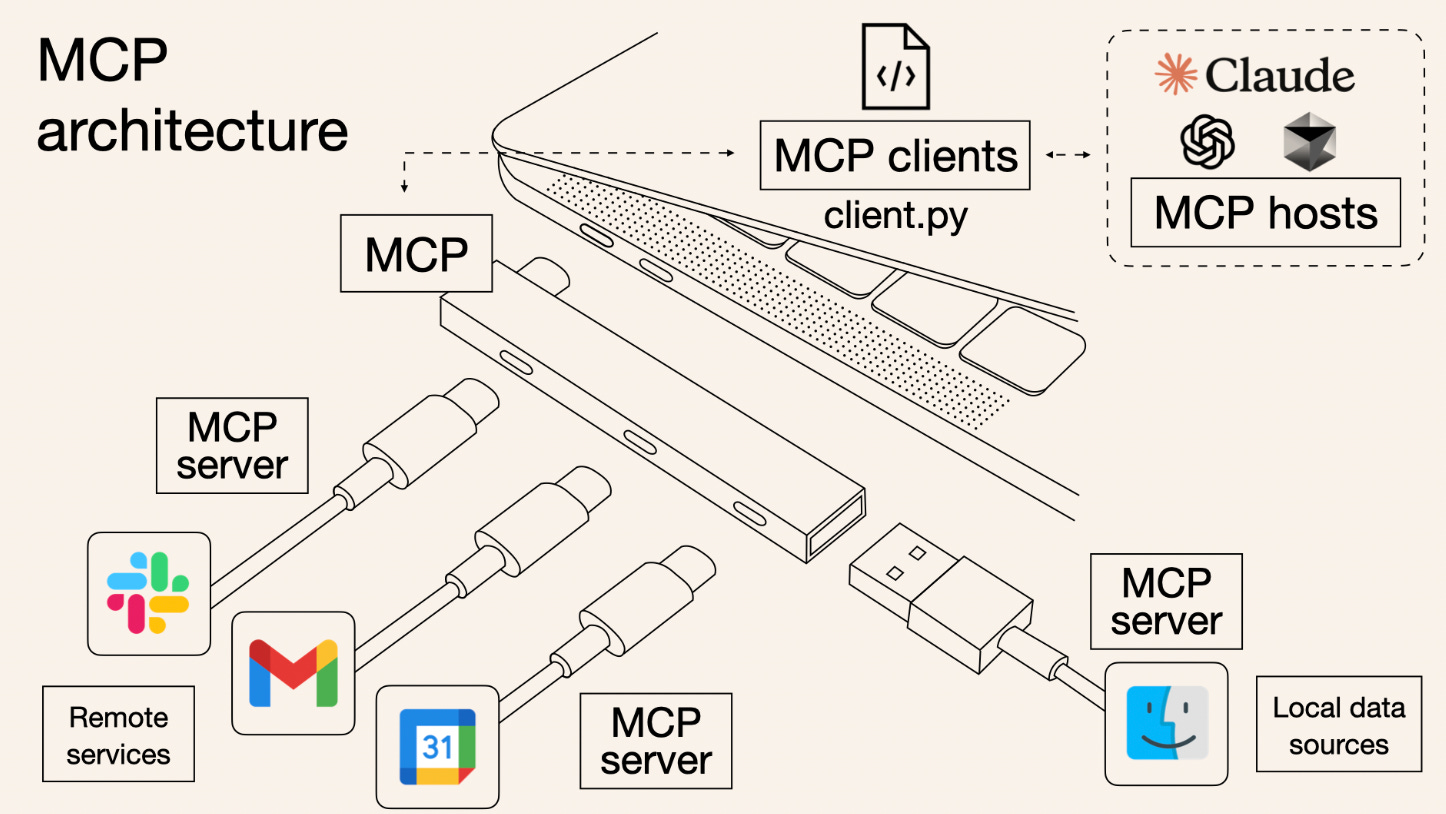
.
🔄 The Evolution: From Messenger Pigeons to Neural Networks
The API Era: Messenger Pigeons with Fixed Routes
Traditional APIs are like messenger pigeons trained to fly fixed routes. They're reliable for predetermined tasks but lack adaptability. When you call an API, you're essentially sending a pigeon with a note saying, "Please bring back the weather forecast for Seattle." The pigeon knows exactly where to go and what to retrieve, but it can't make decisions or adjust its course based on changing conditions.
The MCP Era: Neural Pathways with Adaptive Routing
MCP, on the other hand, is like having a neural network of communication. Instead of rigid pathways, MCP creates a context-aware environment where AI agents can share information, reason about tasks, and collaborate dynamically. It's as if our messenger pigeons evolved into a flock of ravens with collective intelligence, able to adapt their routes, gather additional information, and make decisions based on changing circumstances.
🏗️ MCP Architecture: Building the Neural Highway
MCP's architecture consists of three core components:
Context Management System 🧩: Think of this as the brain's hippocampus, responsible for memory formation and retrieval. It maintains a shared memory space that all agents can access and modify.
Protocol Layer 🔄: The corpus callosum of our system, connecting different brain regions. It defines the communication standards between agents and the context.
Agent Framework 🤖: The specialized neurons of our network, each with unique capabilities but able to communicate through standardized signals.
The Secret Sauce: Context-Aware Communication
Unlike traditional APIs that operate on a request-response model, MCP enables continuous, context-aware communication. It's the difference between having a series of disconnected phone calls (APIs) versus an ongoing group chat where everyone can see and build upon each other's contributions (MCP).
🔍 MCP vs. APIs: Chess vs. Improvisational Jazz
To truly understand the difference between MCP and APIs, think of APIs as chess—a game with strict rules and predetermined moves. Each piece (service) has specific capabilities, and interactions follow rigid patterns.
MCP, however, is like improvisational jazz. The musicians (agents) follow a general structure but can respond to each other in real-time, creating something that emerges from their collective intelligence rather than following a preset score.
Aspect Traditional APIs Model Context Protocol Communication Pattern Request-Response Continuous Context Sharing State Management Stateless or External State Integrated Context Management Adaptability Fixed Endpoints Dynamic Agent Interactions Complexity Handling Requires Explicit Orchestration Emergent Problem-Solving Development Approach Service-Oriented Agent-Oriented
🔮 MCP: The Secret Sauce Unveiled
What makes MCP so powerful? It's all about emergent intelligence through context sharing. Unlike traditional APIs where intelligence is siloed, MCP enables a collective intelligence greater than the sum of its parts.
The Garden vs. The Ecosystem
Think of traditional API-based systems as carefully manicured gardens. Each plant is in its designated spot, and the gardener (the orchestration code) must explicitly manage every interaction. MCP, however, creates an ecosystem where agents can adapt, collaborate, and evolve without explicit instruction.
🧩 Key Components of MCP Architecture
Let's break down the technical architecture in greater detail:
1. Context Management System: The Shared Brain
At the heart of MCP is the Context object—a structured memory space that all agents can access and modify. Unlike the stateless world of APIs, context provides:
Persistent State: Information persists across agent interactions
Structured Access: Data is organized in a way that all agents understand
Versioning: (In advanced implementations) Tracks changes to context over time
2. Protocol Layer: The Universal Translator
The Protocol class defines how agents communicate with the context. It's like creating a universal language that all agents speak, regardless of their internal implementation:
Publish/Subscribe Pattern: Agents publish information to context and subscribe to updates
Validation: Ensures data conforms to expected formats
Access Control: (In advanced implementations) Manages which agents can access specific context sections
3. Agent Framework: The Specialist Experts
Agents are specialized modules with distinct capabilities but a standardized interface:
Capability Declaration: Agents declare what they can do
Context Processing: Agents consume context, perform specialized tasks, and update context
Autonomy: Agents decide what to process based on available context.
City Transportation System Analogy
Think of MCP architecture as a smart city transportation system:
Context Management System: This is the city's central traffic control center. It maintains a complete, real-time map of all vehicles, road conditions, and passenger needs across the entire city. Every bus driver, taxi, and passenger can access this shared information to make better decisions.
Protocol Layer: This is like the standardized communication system used by all transportation services. Whether you're a bus driver, subway operator, or rideshare driver, you use the same radio protocol to report your status and receive updates. This standardization ensures everyone speaks the same "language" regardless of their vehicle type.
Agent Framework: These are the specialized transportation services. Bus services excel at high-volume, fixed routes. Taxis are great for custom destinations. Courier services handle package delivery. Each has unique capabilities but communicates through the standardized protocol to participate in the larger transportation ecosystem.
The magic happens when these components work together. A bus driver might report heavy traffic (context update), which the taxi service sees (context subscription) and uses to reroute its vehicles. Neither service needs to directly coordinate—they simply contribute to and consume from the shared context.
🔄 The MCP Workflow: A Symphony of Collaboration
MCP's workflow resembles a jazz improvisation session more than a classical concert:
Context Initialization: The orchestrator creates an initial context
Agent Registration: Specialized agents join the collaboration
Processing Loop: Agents process and update context in sequence or parallel
Emergent Intelligence: Complex tasks are solved through the collective intelligence of the agent network
🛠️ Building Your Own MCP System: The Constructor's Guide
When implementing your own MCP-based system, several architectural patterns prove particularly valuable:
The Observer Pattern: Agents register as observers for specific context changes, becoming activated only when relevant updates occur. This creates an event-driven architecture where processing happens in response to context changes rather than through explicit orchestration.
The Blackboard Pattern: The context serves as a blackboard where specialized agents contribute knowledge, with the orchestrator managing the solution development process. Unlike traditional systems where data flows linearly through a pipeline, the blackboard allows non-linear, opportunistic problem-solving.
The Publish-Subscribe Pattern: Agents publish information to specific "topics" in the context and subscribe to topics they're interested in processing. This decouples producers from consumers, allowing the system to evolve without requiring changes to agent interconnections.
Hospital Emergency Department Analogy
Creating an MCP system is like designing a hospital emergency department:
Start with the Shared Context: First, create the central information hub—similar to the ED's central monitoring station where all patient data is visible to the entire team.
Define Communication Protocols: Establish how information flows—like the hospital's standardized handoff procedures where nurses, doctors, and specialists use consistent formats to share patient status.
Create Specialized Agents: Develop teams with distinct expertise—similar to how ED teams include triage nurses (initial assessment), lab technicians (testing), radiologists (imaging), and attending physicians (diagnosis and treatment).
Implement Coordination Patterns:
The "Observer Pattern" works like the hospital paging system—specialists are automatically notified when relevant test results arrive.
The "Blackboard Pattern" resembles the patient chart—all team members contribute information to a single source of truth that guides collective decision-making.
Real-World Example: Consider a hospital treating a trauma patient. The triage nurse enters vital signs (context initialization), which triggers automated alerts to appropriate specialists (observer pattern). The radiologist adds imaging results to the patient chart (blackboard pattern), which the surgeon uses to make treatment decisions. No team member directly manages others, yet they collectively provide coordinated care by contributing to and acting on shared information.
🔍 The Future of MCP: Neural Networks All the Way Down
As MCP evolves, we can expect:
Self-organizing Agent Networks: Agents that discover optimal collaboration patterns
Dynamic Agent Creation: New agents spawned based on task requirements
Federated MCP Networks: MCP systems collaborating across organizational boundaries
Human-in-the-loop MCP: Seamless integration of human expertise within the agent network
🔄 Coming Soon: Exploring ANP - The Agent Network Protocol
In our next series of blog posts, we'll dive into another groundbreaking protocol in the AI agent ecosystem: the Agent Network Protocol (ANP). While sharing some conceptual similarities with MCP, ANP takes a fundamentally different approach to agent communication.
Key differences between ANP and MCP include:
ANP uses a P2P architecture, whereas MCP follows a client-server model
ANP relies on W3C DID for decentralized identity authentication, while MCP utilizes OAuth
ANP organizes information using Semantic Web and Linked Data principles, whereas MCP employs JSON-RPC
Stay tuned for our deep dive into ANP, where we'll explore its architecture, implementation patterns, and real-world applications! If you're eager to learn more before our next post, check out this detailed comparison of ANP and MCP in the GitHub repository: https://github.com/agent-network-protocol/AgentNetworkProtocol/blob/main/blogs/Comparison-of-MCP-and-ANP-What-Kind-of-Communication-Protocol-Do-Agents-Need.md