
Mastering Claude Code Plan Mode: The Game-Changing Feature Every Engineer Needs
Anthropic just dropped a feature that will change how engineers approach complex coding tasks. Plan Mode is fundamental shift toward more thoughtful, senior-level engineering practices.

What is Plan Mode?
Plan Mode is a special operating mode in Claude Code that creates a read-only research and planning phase before any code changes are made. Think of it as putting your AI assistant into "architect mode" where it can only observe, analyze, and plan but never execute.
Key Access: Simply press Shift + Tab twice to enter Plan Mode instantly.
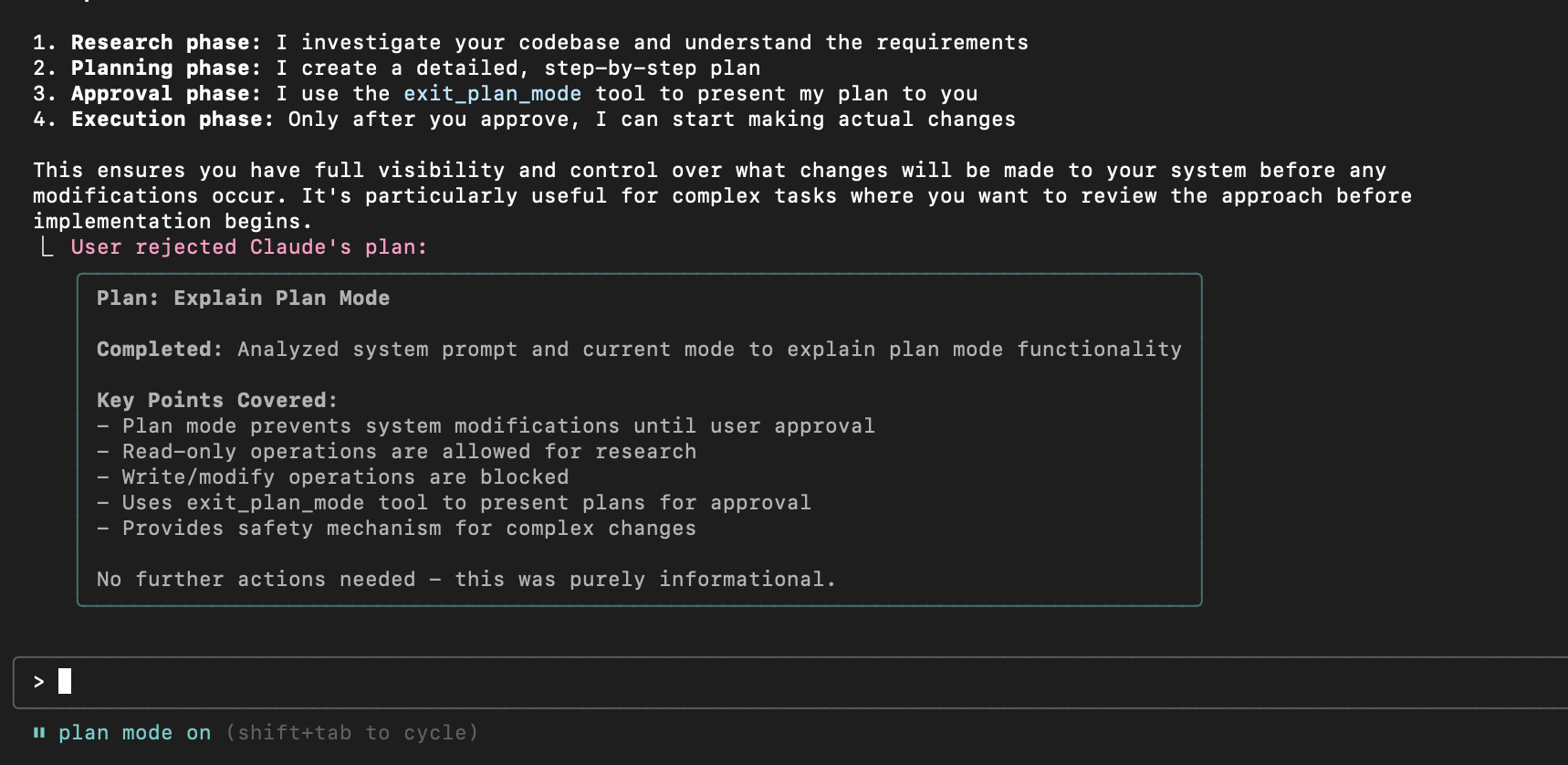
How Plan Mode Works
The Four-Phase Process:
Research & Analyze - Read files, search code, understand the codebase structure
Create a Plan - Develop comprehensive implementation strategy
Present for Approval - Use the
exit_plan_modetool to show proposed changesWait for Confirmation - No changes happen until you explicitly approve
What Plan Mode CAN Do:
✅ Read any files in your codebase
✅ Search through code and documentation
✅ Analyze project structure and dependencies
✅ Build up context about your requirements
✅ Design solutions and implementation strategies
What Plan Mode CANNOT Do:
❌ Create, modify, or delete any files
❌ Run commands that change system state
❌ Make git commits
❌ Install packages or modify configurations
Two Powerful Approaches to Plan Mode
Approach 1: Plan → Code
Perfect for smaller, straightforward tasks:
Enter Plan Mode
Let Claude research and create a plan
Approve the plan
Claude executes immediately
Approach 2: Plan → Spec File → Execute (Recommended)
Ideal for mid-to-large features:
Enter Plan Mode
Have Claude write a detailed specification file
Review and iterate on the spec
Commit the spec to your repository
Execute against the finalized specification
Why This Mirrors Senior Engineering Workflow
The best engineers don't just start coding they:
Understand first - Gather context about the problem and codebase
Plan thoroughly - Design the solution before implementation
Get alignment - Ensure stakeholders understand the approach
Execute confidently - Build with a clear roadmap
Plan Mode enforces this exact workflow, preventing the common AI coding pitfall of "ready, fire, aim."
Practical Benefits for Engineering Teams
Context Loading Without Side Effects
Plan Mode lets you prime your AI assistant with relevant codebase information without worrying about accidental changes. It's like having a senior engineer review your entire codebase before suggesting solutions.
Reviewable Implementation Plans
By writing plans to specification files, you create:
Documentation of your implementation approach
Reviewable artifacts that can be improved before coding
Historical records of architectural decisions
Shareable plans across team members
Reduced Cognitive Load
Instead of juggling planning and implementation simultaneously, Plan Mode lets you focus entirely on strategy first, then execution second.
Higher Success Rates
Well-planned implementations consistently outperform ad-hoc coding. Plan Mode systematically improves your code quality by enforcing the planning phase.
Best Practices for Plan Mode
Ask Clarifying Questions
Use Plan Mode to validate assumptions and ask "stupid questions" without judgment:
"Correct me if I'm wrong, but the purpose of Plan Mode is to..."
"Can you explain exactly what files will be modified?"
Use Neutral Language
Phrases like "correct me if I'm wrong" help reduce AI bias and get more accurate responses.
Load Context Strategically
Prime your assistant with the most relevant files and information before diving into complex planning.
Iterate on Plans
Don't accept the first plan, refine it, ask follow-up questions, and ensure it addresses edge cases.
The Bigger Picture: Engineering in the AI Age
Plan Mode represents a fundamental shift in how we work with AI coding tools. We're moving from:
"AI, write this code" → "AI, help me plan this feature"
Reactive debugging → Proactive architecture
Single-shot prompts → Iterative planning cycles
The winning engineers and teams are those who set up their codebases and workflows not just for themselves, but for their AI agents. Plan Mode is a crucial tool in this transition.
Getting Started
Install Claude Code and ensure you're using the latest version
Try Plan Mode on your next feature with
[Shift + Tab]twice.Start small - Use it for bug fixes before tackling major features
Create specs - Practice writing implementation plans to files
Iterate - Refine your planning process based on what works
The Approach 2 (Plan to Spec File to Execute) is the one that actually scaled for me. For smaller stuff, Plan then Code works fine. But the moment a feature touches more than a few files, having that spec file committed to the repo is what saves you when context gets compacted or you start a fresh session.
Since this was published, a best practices guide dropped that codifies this exact workflow into four phases: explore, plan, implement, commit. Covered it here https://reading.sh/context-is-the-new-skill-lessons-from-the-claude-code-best-practices-guide-3d27c2b2f1d8?postPublishedType=repub and the key insight they added is the verification layer. Plan Mode gets you the right architecture, but adding tests and type checks into the loop is what actually catches the drift between plan and implementation.
One thing I'd push back on slightly: the "reduced cognitive load" framing undersells it. It's not just that you think less during implementation. It's that Plan Mode front-loads the context loading, so by the time you switch to normal mode the model already has a working map of the codebase. That's the real gain.